Structure
The frame
Concrete
Show meHelp with your choice
Answer in brief
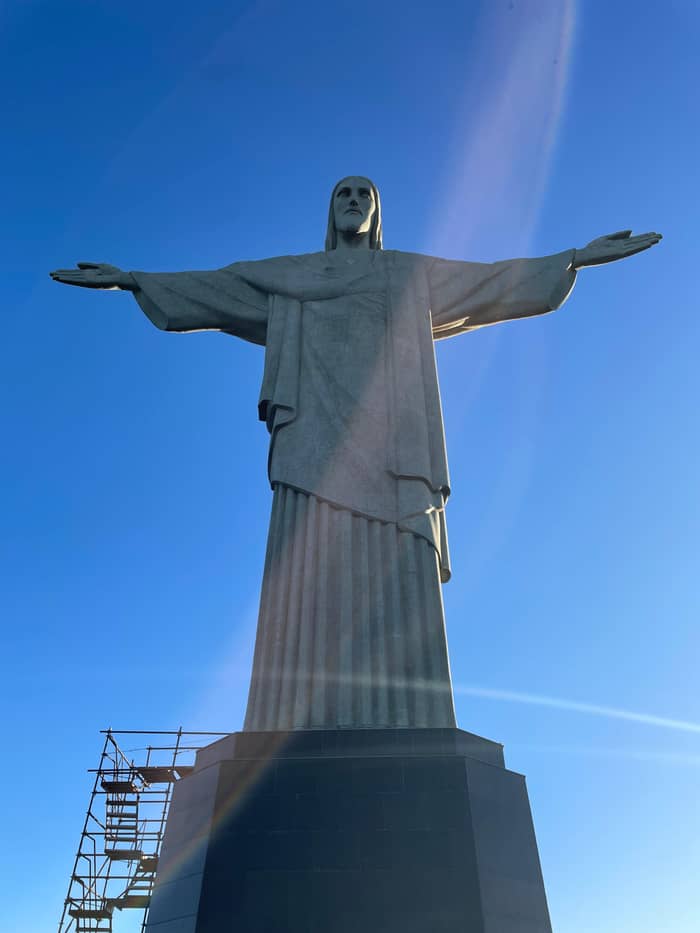
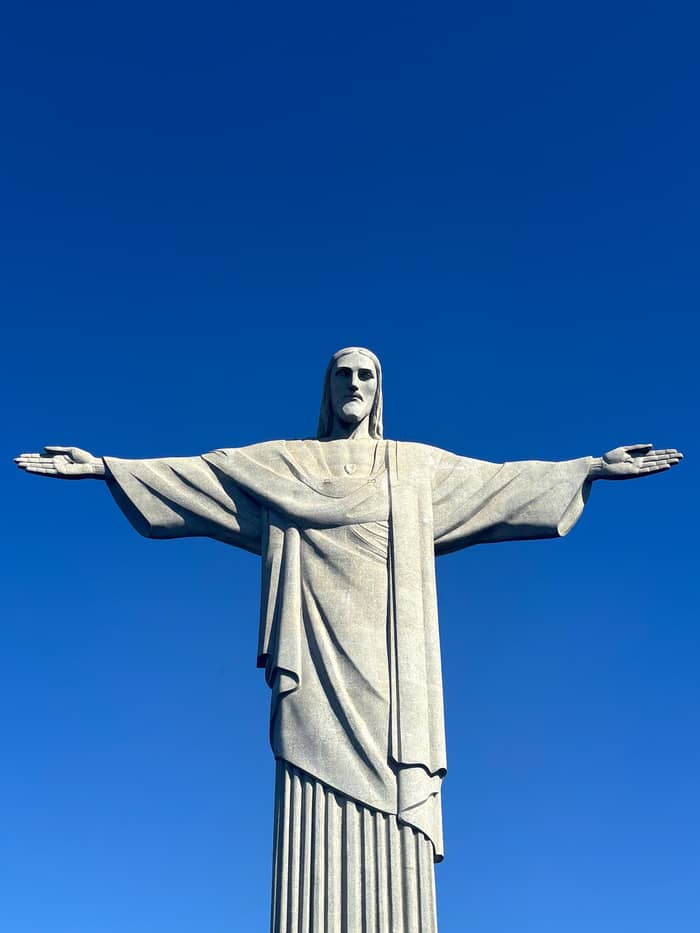
The Christ the Redeemer statue was built as a reinforced concrete frame covered in a mosaic of soapstone triangles, with the head and hands molded in France and the materials carried up by the Corcovado railway.
How it was made
Two questions, one way to see it
Say what interests you and how you like to explore, and an option appears with its starting price.
Best match for you
from $48
Ride the rack railway up and enter at the time you choose.
Best match for you
from $61
4 hours with pickup and a live guide.
Best match for you
from $75
5 to 6 hours through the forest to the statue.
Best match for you
from $73
7 hours with pickup, including Tijuca National Park.
Best match for you
from $149
4 hours by jeep or SUV, private group, separate entrance.
How was the Christ the Redeemer statue built on a bare mountain top? With a concrete frame, a skin of hand-laid soapstone, molds from Paris and a rack railway that carried everything up.
Editorial team, christtheredeemertour.top · Updated November 11, 2026 · Read in 6 min
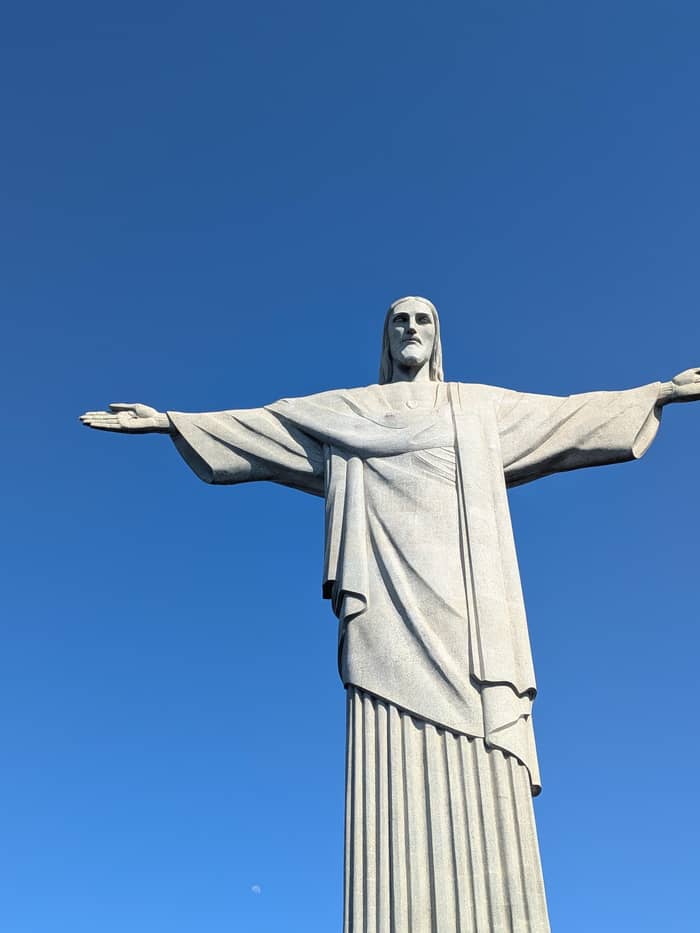
How was the Christ the Redeemer statue built so that it still stands on an exposed summit? The answer is a hidden frame. The sanctuary explains that the structure is reinforced concrete, finished with a covering of soapstone,1 and that small pieces of stone form the mosaic that covers the surface and gives texture to the robe, the face and every other detail.6
Reinforced concrete was still a modern material at the time, and the designer went to an expert. In Paris, Heitor da Silva Costa worked with Albert Caquot, an engineer who specialized in it, alongside the sculptor Paul Landowski.7 Concrete made it possible to cast a figure whose long, open arms reach out over the drop on either side of the summit.
The design was also trimmed to suit the site. Among the changes made before work began was a cut in height from 42 to 38 meters, built in reinforced concrete.8 The finished figure has simple, flowing lines that the sanctuary links to Art Deco, the style of the early 20th century,9 which also suited a surface made of thousands of small flat pieces.
Materials
| Part | Material | Detail |
|---|---|---|
| Frame | Reinforced concrete1 | Engineered with Caquot7 |
| Skin | Soapstone mosaic6 | Small triangles on fabric2 |
| Head | Molded in France3 | Assembled from 50 parts22 |
| Hands | Molded in France3 | With the marks of the nails23 |
| Heart | Carved on the chest24 | About 1.30 m25 |
| Inside | Hollow26 | Passages and stairs26 |
From the sanctuary, the official van concession and São Paulo's state assembly history.1,3,22
How long did it take to build Christ the Redeemer? It depends where you start the clock. A foundation stone went down on 4 April 1922, but work on the summit itself did not start until mid 1926,10 and the statue was unveiled on 12 October 1931.13 Tijuca National Park describes the summit works as about five years long.5
The railway's own records give another measure. The train operator says it hauled the monument's parts uphill for four consecutive years,18 covering the years when the figure was actually rising on the summit. The years before 1926 were spent on calculations, plans and design changes rather than on the mountain.10
Money mattered as much as engineering. The sanctuary's own accounts stress that donations from ordinary Brazilians turned the plan into a statue,19 and in 1922 more than 20,000 women had already put their names to a petition backing it.20 Building on a summit with public money meant progress came step by step, as the funds and the materials arrived.
The most delicate parts were shaped far from Rio. The sanctuary credits Landowski with sculpting the figure and preparing the head and hand molds,27 and the van concession explains that the statue was built almost entirely in Brazil, except the head and hands, which were molded in France and shipped across.3 The face itself is attributed to the Romanian artist Gheorghe Leonida.28
The head did not travel in a single piece. A history from São Paulo's state assembly says it was put together from 50 parts.22 A historic photograph in the sanctuary's collection shows it surrounded by scaffolding, a record of the sculptural detail being fixed in place.33 Today you can see the mold of the head itself in the anniversary exhibition at the Paineiras visitor center.30
Seeing that mold changes how you look at the statue. From the platform the face seems calm and simple, yet the mold shows how much patient modeling lies behind that calm. The hands, with the marks of the crucifixion that the sanctuary points out,23 were shaped the same way: bold enough to be seen from far off, precise enough to bear a close look.
Every load had to climb a mountain. The sanctuary calls the Corcovado railway essential for carrying the materials to the top,4 and the line was well suited to the job: it had been running since 1884,35 and in 1910 electric machines replaced the steam engines on its steep 3,824-meter track.36 It remains the classic way up for visitors today.
The construction team lived with the mountain too. Heitor Levy, who ran the work on site as executing architect,37 made his home on the summit while the statue went up, running the site from an office inside the pedestal.34 Historic photographs in the sanctuary's archive show the monument wrapped in scaffolding at different stages of construction,38 with the city spread out far below the workers.
Picture the summit then: a narrow rock platform, wind and cloud rolling in from the sea, scaffolding lashed around a rising concrete figure, and the little train climbing through the forest with its loads. Christ the Redeemer statue construction was a feat of logistics as much as of art, and the railway was the thread that held it together.
See it yourself
Compare the train and guided days.
Compare 3 choices
Compare the train and guided days.
≈
View≈
View≈
ViewConverted at the ECB reference rate, from-prices as listed by GetYourGuide. The precise amount is shown when you book.
The build
For the surface, Silva Costa chose soapstone, a stone the sanctuary describes as beautiful, easy to work, resistant to erosion and plentiful in Brazil.39 It was cut into thousands of small triangles, glued by hand onto fabric and then applied to the statue by the mosaic workers.2 The result is a skin of tiny tiles that softens the light and gives the figure its pale, slightly textured glow.
This was a community effort. Women volunteers helped prepare the soapstone pieces, and some wrote the names of family members and loved ones on the back.29 The ladies of the Catholic Circle, the sanctuary's timeline adds, wrote the names of relatives and donors on the triangles while they glued them to the fabric.40 Those names are still there, hidden against the concrete.
Stand under the statue and look closely at the robe or the hands: you can see the grid of triangles, each placed by a person. Knowing that names are written on the back of the stone makes the surface feel less like a finish and more like a signature book, signed by people whose names you will never read.
Video
GoDocs on YouTube · The video waits until you tap play to load.
The pieces were cut into thousands of triangles, glued by hand onto a fabric and then applied to the statue by the mosaic workers.
At the top
The statue is not solid. A network of internal passages and stairs gives maintenance crews a route up into the arms and head, and the public is kept out of it.26 The sanctuary invites the curious to explore it through its virtual Olhar do Redentor experience instead.32
The heart on the chest was a late addition with a meaning. In 1929 Archbishop Sebastião Leme asked for a heart to be molded on the statue's chest,12 and it represents the Sacred Heart of Jesus.24 It measures about 1.30 m, and Levy and Viana sealed a glass vessel holding papers about their families inside it.25
A replica of that heart is on show in the anniversary exhibition at Paineiras, next to the head mold and the statue's original lightning rod structure, which was shaped like a crown.30 Seeing them at eye level is the closest you can get to the inside of the monument, and it is free to enter.31
A stone skin on a stormy peak needs constant care. The sanctuary says the exposed monument needs inspections, cleaning and repairs,41 and restoration work on the statue is the job of the Archdiocesan Mitra, which announces it.42 A restoration completed in 2010 after some four months of work brought the statue back into public view with a renewed face.15
In 2014 another campaign began with the thumbs, damaged by lightning, and went on to restore the soapstone mosaic.16 During that work the lightning rods were extended and the protection improved.17 The surroundings have been rebuilt over the years as well: the lookouts, stairs and protective walls that Heitor da Silva Costa designed were inaugurated in 1945.14
Access keeps changing too. The escalators now being replaced had run since 2003,43 and the new set, with its inclined elevators, has been authorized by IPHAN, the national heritage institute.44 Since 2000, when the statue received new lighting, the monument and its approaches have been under continuous renewal, in the train operator's words.45
FAQ
A reinforced concrete structure with a soapstone mosaic covering.1
They were molded there and brought to Rio; the rest was built in Brazil.3
São Paulo's state assembly counts 50 parts in its history.22
The train carried the pieces for four consecutive years.18
A French specialist in reinforced concrete.7
They let staff reach the arms and head; visitors cannot enter.26
It was cut to 38 meters before building.8
Sources
Going up Corcovado? Ask a real person here.